
Construction Site Visitor Management: Beyond Paper Logs
Paper visitor logs can leave gaps in jobsite visibility, security and accountability. Discover how digital construction site visitor management can give US contractors a clearer, real-time view of who is on site.
Construction site visitor management: why it's time to move beyond paper sign-in logs
Ask a superintendent, safety manager or security lead on a US jobsite whether they know exactly who is on site right now, and many can answer with confidence for their workforce. On well-run projects, badged workers, access-controlled gates and time and attendance records give a clear picture of who is there.
Ask the same question about visitors, and the answer gets a lot less certain.
In our product team's experience of US jobsites, visitor management is highly inconsistent. Practices range from a paper sign-in book, to a spreadsheet maintained in the site office, to a guard holding a driver's license at the gate. Even where some form of digital logging exists, the most advanced option our team commonly sees is a spreadsheet. That is a digital version of writing your name on a piece of paper, disconnected from everything else happening on site. [Editorial note: this is an observation from Biosite's product team, not an industry-wide statistic. Verify any claim about how common each method is externally.]
Commercial construction is booming, from data centers and manufacturing plants to large industrial and pharmaceutical projects, which likely means busier gates and more people to account for. Owners' representatives, building inspectors, equipment vendors and others all arrive as "visitors." The term covers a broad population, and each of them matters when something goes wrong.
Manual visitor logs are becoming a liability. Here is why, and what a better approach looks like.
How visitors are managed on US jobsites today
On many projects, the general contractor is expected to be accountable for everyone on the property, workers and visitors alike. Yet the visitor journey can still look something like this:
- A visitor arrives at the gate or site office
- They sign a paper log or type their name into a spreadsheet
- Someone may request and hold a form of ID, typically a driver's license
- They're pointed toward the person they're visiting
- Their departure may or may not be recorded
Each step relies on a person remembering to do something, and on the record being maintained accurately afterward. The process feels adequate on a quiet day and can fall short when accuracy matters most.
The operational problems with paper and spreadsheet visitor logs
You can't answer "who is on site right now?"
A paper construction visitor log tells you who signed in, not who is actually present. A visitor may finish their meeting and head straight for the exit without returning to the office, or skip the sign-out step entirely. Over the course of a day, the log can drift away from reality. For a role whose mandate is total visibility of the site population, that is a meaningful gap.
Visitors aren't reliably linked to a host
On US jobsites, a visitor is typically assigned a host or escort, the person accountable for them while they're on the property. With manual processes, that link may exist only informally. If the host is called away, leaves site or hands the visitor to a colleague, there may be no record of the change. When you need to locate a visitor quickly, there's no documented chain of custody showing who was responsible for them or where they were last seen.
Emergency and muster visibility breaks down
This is where manual visitor logging carries real risk. If the site needs to muster, whether for a fire event, a weather alert or any incident requiring evacuation and headcount, the workforce may be accounted for through access control and badge data. Visitors, however, may exist only in a paper book or a spreadsheet that someone has to physically retrieve. A visitor unfamiliar with the site layout may not know where the nearest shelter point or assembly area is. If they can't be accounted for, the response team is searching for someone with no record of their last location, no contact number, and no way to reach the person who was hosting them. [Verify any regulatory references on muster and evacuation requirements externally; none are cited here.]
Check-in friction and manual administration
Every visitor processed manually at the gate takes time from the visitor, from the guard or admin, and from the host who has to be tracked down and notified. On large campuses with high in-and-out traffic, that friction can add up to congestion at entry points and administrative time spent transcribing, filing and chasing records.
Audit and compliance gaps
Owners often expect general contractors to demonstrate accountability for everyone on the property, and that expectation can extend to documentation requirements such as safety acknowledgements, privacy notices or NDAs for certain visitor types. With paper processes, proving that a specific visitor completed a specific requirement on a specific date means hoping the right piece of paper still exists. A handwritten log is a weak foundation for an audit trail. (Specific owner or regulatory documentation requirements vary by project and jurisdiction. Verify against your contract and local requirements, including any US privacy requirements.)
Security blind spots
Site security is only as strong as its weakest entry process. If workforce access is tightly controlled but a visitor can sign an illegible name in a book and walk on, the perimeter has a gap. Unaccounted-for visitors also complicate loss prevention: when equipment goes missing or an incident occurs, an incomplete visitor record limits your ability to establish who was on site and when.
What good jobsite visitor management looks like?
Digital visitor management doesn't need to be complicated. It means applying the same discipline to visitors that well-run sites already apply to their workforce, scaled to the smaller amount of information a visitor needs to provide. The core elements:
Pre-registration before arrival. When a visit is known in advance, the host sends a digital invitation. The visitor registers basic details (name, company, who they're visiting, when) before they ever reach the gate. The site team sees an expected visitor, and the visitor receives clear arrival instructions ("report to gate 2," "park in lot A") configured by the site. On-demand registration handles unannounced arrivals on a site device or the visitor's own phone.
A documented host. Every visitor is digitally linked to a responsible person. If the host changes, the record changes with them, which gives you a clear, auditable chain of accountability. Anyone greeting the visitor can see the host's details and notify them instantly that their guest has arrived.
A live digital visitor log. Check-in and check-out are recorded in real time, so the site team always knows which visitors are currently on the property. Visitors show up separately from the general worker population, so they stand out when it matters.
Inclusion in emergency and muster processes. Visitors appear in roll call and headcount workflows alongside workers, with contact details for both visitor and host available immediately from a mobile device, not from a binder in the guard shack.
Flexible rules by visitor type. A building inspector, an owner's representative attending an office meeting, and a vendor entering the construction zone don't all carry the same requirements. Site teams should be able to define what "visitor" means for their project, including which documentation, badging or escort rules apply, and vary those rules within the same project.
Records that persist. Visit history, completed acknowledgements and returning-visitor profiles are stored digitally, so audits don't depend on paper and repeat visitors don't start from scratch.
Connecting visitors to your workforce and access ecosystem
The biggest step-change comes from integrating visitor management with the workforce management and site access processes you already run, which goes well beyond digitizing the sign-in sheet.
When visitor management sits inside the same system as your workforce registry and access control:
- Site teams get one view of the entire site population, workers and visitors together, rather than two disconnected records
- Existing badging and scanning equipment can be reused for visitor badges where sites choose to issue them, so there's minimal new hardware or process to adopt
- Teams already using the workforce platform need only a brief overview, which means one less product to learn and one less system to maintain
- Visitor data flows into the same reporting, muster and audit workflows as workforce data
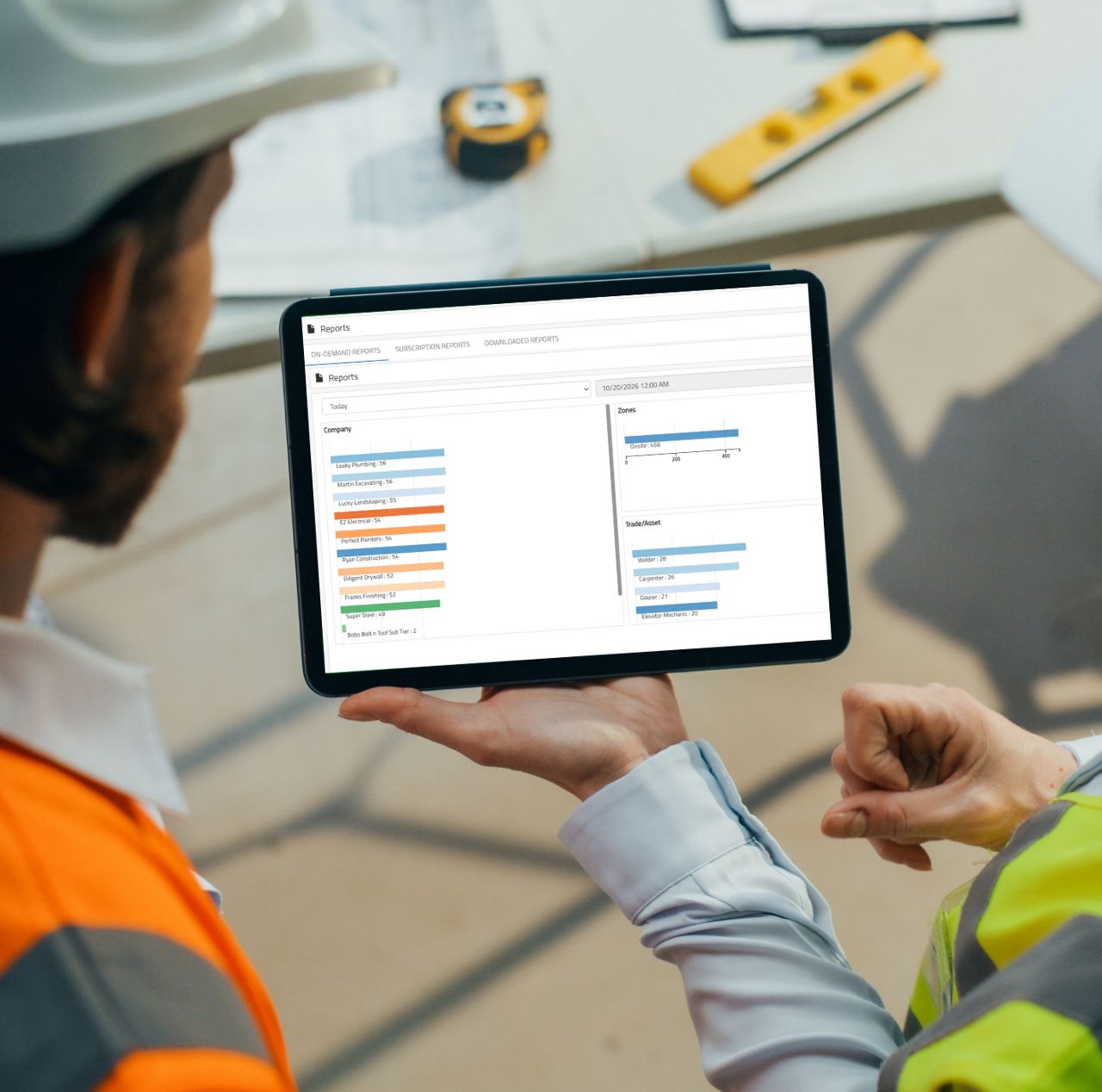
Biosite has taken this approach with the visitor management capability in CrewSight, our workforce management and jobsite access control software trusted by General Contractors since 2014. Visitor management is an integrated module within CrewSight rather than a standalone tool. Site teams can pre-register, admit, track and check out visitors through the same portal they use to manage the workforce. Configurable fields let sites capture what's unique to each project, and live dashboards show the visitor count separately from the general population. As part of ASSA ABLOY, the global leader in access solutions, Biosite builds these tools for the realities of construction: temporary setups, changing entry points and a transient population.
The takeaway
Visitor management is often treated as an administrative afterthought until something goes wrong. An inspector's visit that can't be evidenced, an evacuation headcount that doesn't reconcile, a security incident with an illegible sign-in book as the only record: these are the moments when the paper log becomes a genuine liability.
The standard to aim for is simple. Know who is on your jobsite, workers and visitors alike, in real time, with a clear host for every visitor, a reliable digital record of every visit, and visitors included in your emergency processes by default. For most sites, getting there means extending the workforce management discipline you already have, rather than adding another disconnected tool.